


Many people believe that weight loss should be straightforward: eat less, exercise more, lose weight, and keep the weight off forever.
In reality, sustainable weight loss is rarely linear. Many individuals experience periods of progress, plateaus, setbacks, and even weight regain before achieving lasting success. This real patient story highlights how medical weight management, lifestyle changes, and perseverance helped one woman lose 16 kg, improve her Type 2 Diabetes control, reduce her medication burden, and maintain her results over the long term.
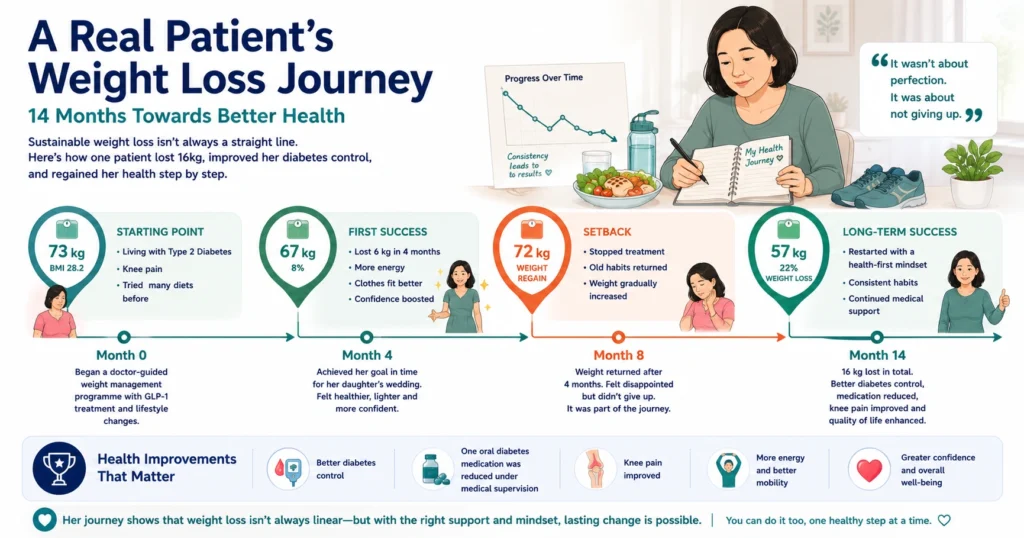
Key Results at a Glance
Before diving into her story, here is a summary of her progress:
- Starting weight: 73 kg
- Current weight: 57 kg
- Total weight loss: 16 kg
- Percentage of body weight lost: 22%
- BMI improved from 28.2 kg/m² to 22.0 kg/m²
- Her diabetes control improved on follow-up, and one oral diabetes medication was reduced under medical supervision.
- Knee pain improved as her weight decreased
- She continued to lose weight and maintain her progress over 14 months after restarting treatment
While every patient’s journey is unique, her experience demonstrates that sustainable weight loss is possible with the right combination of medical support, lifestyle modifications, and long-term commitment.
The Beginning of Her Medical Weight Management Journey
When she first reached out to us for help with weight management, she was 161 cm tall and weighed 73 kg, giving her a Body Mass Index (BMI) of 28.2 kg/m².
She had been struggling with her weight for many years. Like many individuals living with excess weight, she had tried various diets and wellness programmes in the past. While some approaches helped her lose weight initially, maintaining the results proved far more difficult.
In addition to her weight concerns, she was also living with Type 2 Diabetes. Her diabetes was moderately controlled with oral medications, but her blood sugar levels remained above her ideal targets. She understood that carrying excess weight could contribute to worsening diabetes control and increase her risk of long-term health complications.
At the same time, an important family milestone was approaching—her daughter’s wedding.
Like many parents, she wanted to look and feel her best for such a memorable occasion. She hoped to improve her confidence, feel healthier, and enjoy the celebration without feeling self-conscious about her weight.
After discussing her goals and medical history, she decided to embark on a medically supervised weight management programme that combined lifestyle modification with treatment using an injectable GLP-1 receptor agonist.
Early Success and Renewed Confidence
Over the next four months, she committed herself fully to the programme.
She became more mindful of her eating habits, paid closer attention to portion sizes, and gradually incorporated healthier choices into her daily routine. The injectable GLP-1 treatment helped reduce her appetite and made it easier for her to stay on track without constantly battling hunger or cravings.
The results were encouraging.
Within four months, her weight decreased from 73 kg to 67 kg (8%).
The changes became noticeable not only on the weighing scale but also in her daily life. Her clothes fit more comfortably, she felt lighter and more energetic, and her confidence steadily improved.
By the time her daughter’s wedding arrived, many friends and family members commented on how healthy and radiant she looked. Several guests were surprised by her transformation and asked how she had managed to lose weight so successfully.
She felt proud of what she had achieved and thoroughly enjoyed celebrating one of the most important milestones in her daughter’s life.
For a moment, it felt as though she had reached her goal.
When Weight Starts to Return
However, weight loss and weight maintenance are often two very different challenges.
After the wedding, life gradually returned to normal. The strong motivation that had driven her during the previous months naturally faded. Without a major event to work towards, it became harder to maintain the same level of focus and discipline.
Eventually, she stopped treatment.
Over time, old habits slowly began to reappear. Portion sizes increased, dietary choices became less consistent, and the structure that had helped her stay on track gradually disappeared.
Within four months, her weight had increased to 72 kg.
She felt disappointed and frustrated. Seeing the weight return after months of hard work was discouraging. However, she soon realised that her experience was not uncommon. Many individuals experience weight regain after stopping treatment, especially when long-term lifestyle habits have not yet become firmly established.
Most importantly, she did not view the setback as a failure.
Instead, she viewed it as part of the journey.
A Turning Point: When Health Became the Priority
The true turning point came when she began experiencing knee pain during exercise.
Activities that had once felt manageable became increasingly uncomfortable. Walking longer distances, climbing stairs, and participating in physical activities required more effort and caused increasing discomfort.
For the first time, she realised that her weight was affecting far more than her appearance.
It was affecting her mobility, physical function, and quality of life.
At the same time, she knew that improving her weight could positively impact her diabetes control and reduce her long-term health risks.
This time, her motivation was different.
She was no longer trying to lose weight for a wedding.
She wanted to lose weight for her health.
Taking a More Sustainable Approach
Determined to make a lasting change, she decided to restart her weight management journey.
Following a review with our medical team, she began treatment with an injectable dual GLP-1/GIP receptor agonist as part of a comprehensive long-term weight management programme.
This time, her mindset had changed significantly.
Rather than focusing solely on the number on the weighing scale, she focused on developing habits that she could realistically maintain for years.
She prioritised protein intake, improved meal planning, reduced unnecessary snacking, and gradually increased her physical activity as her knee symptoms improved.
The medication helped reduce cravings and improve appetite control, making it easier for her to adhere to healthier eating habits.
Four months after restarting treatment, her weight had fallen from 72 kg to 65 kg (10%).
More importantly, she felt in control again.
Instead of chasing rapid weight loss, she focused on consistency and sustainability.
Beyond Weight Loss: Improving Diabetes Control
As her weight continued to decrease, she began noticing improvements that extended far beyond the numbers on the scale.
Her blood sugar control improved steadily.
Follow-up reviews demonstrated meaningful improvements in her diabetes management. As her weight decreased and her metabolic health improved, her doctor was eventually able to reduce one of her oral diabetes medications, and her HbA1c improved from 7.6% to 7% or lower.
This represented a significant milestone for her.
The improvements reinforced what research has consistently shown: sustainable weight loss can meaningfully impact Type 2 Diabetes management and overall metabolic health.
For her, the benefits of weight loss extended far beyond appearance.
She felt healthier, more energetic, and more confident in her ability to take control of her long-term health.
Fourteen Months Later
Today, fourteen months after restarting her journey, she weighs 57 kg.
From her original weight of 73 kg, she has lost 16 kg, approximately 22% of her initial body weight.
Her BMI has improved from 28.2 kg/m² to 22.0 kg/m².
Her knee pain has improved significantly. Her diabetes is better controlled. She feels more energetic throughout the day and can participate in activities that previously felt challenging.
Most importantly, she no longer views weight management as a short-term project.
She understands that maintaining a healthy weight requires ongoing attention, realistic expectations, and sustainable habits.
Today, she remains on a maintenance programme and continues practising the lifestyle habits that helped her achieve her success.
The Lessons from Her Journey
Her story reminds us that successful weight loss is rarely linear.
There may be periods of rapid progress, plateaus, setbacks, and even weight regain. These experiences do not mean that someone has failed. In many cases, they are simply part of the process.
Medical weight management treatments, including injectable GLP-1 receptor agonists and GLP-1/GIP receptor agonists, can be valuable tools for eligible individuals struggling with excess weight and obesity-related conditions such as Type 2 Diabetes. However, medications work best when combined with sustainable lifestyle modifications, realistic goals, and ongoing support.
The most important lesson from her journey is not how much weight she lost.
It is that she never gave up.
And ultimately, that persistence made all the difference.
Disclaimer
This article describes the experience of a real patient whose details have been anonymised to protect privacy. Individual results vary, and not all patients will achieve the same degree of weight loss. Weight loss outcomes depend on multiple factors, including medical conditions, lifestyle habits, dietary adherence, physical activity levels, and treatment response.
Medications used for weight management should only be prescribed after an appropriate medical assessment by a qualified healthcare professional. While injectable GLP-1 receptor agonists and GLP-1/GIP receptor agonists can be effective tools for weight management, they work best when combined with sustainable lifestyle modifications, including a balanced diet and regular physical activity.
These medications are not suitable for everyone. They may cause side effects such as nausea, vomiting, diarrhoea, abdominal discomfort, and low blood sugar when combined with certain diabetes medications. Rare but serious risks, including pancreatitis, gallbladder problems, worsening diabetic retinopathy, and other safety concerns, should be discussed with a doctor before treatment.
The information provided in this article is intended for educational purposes only and should not be considered personalised medical advice.