

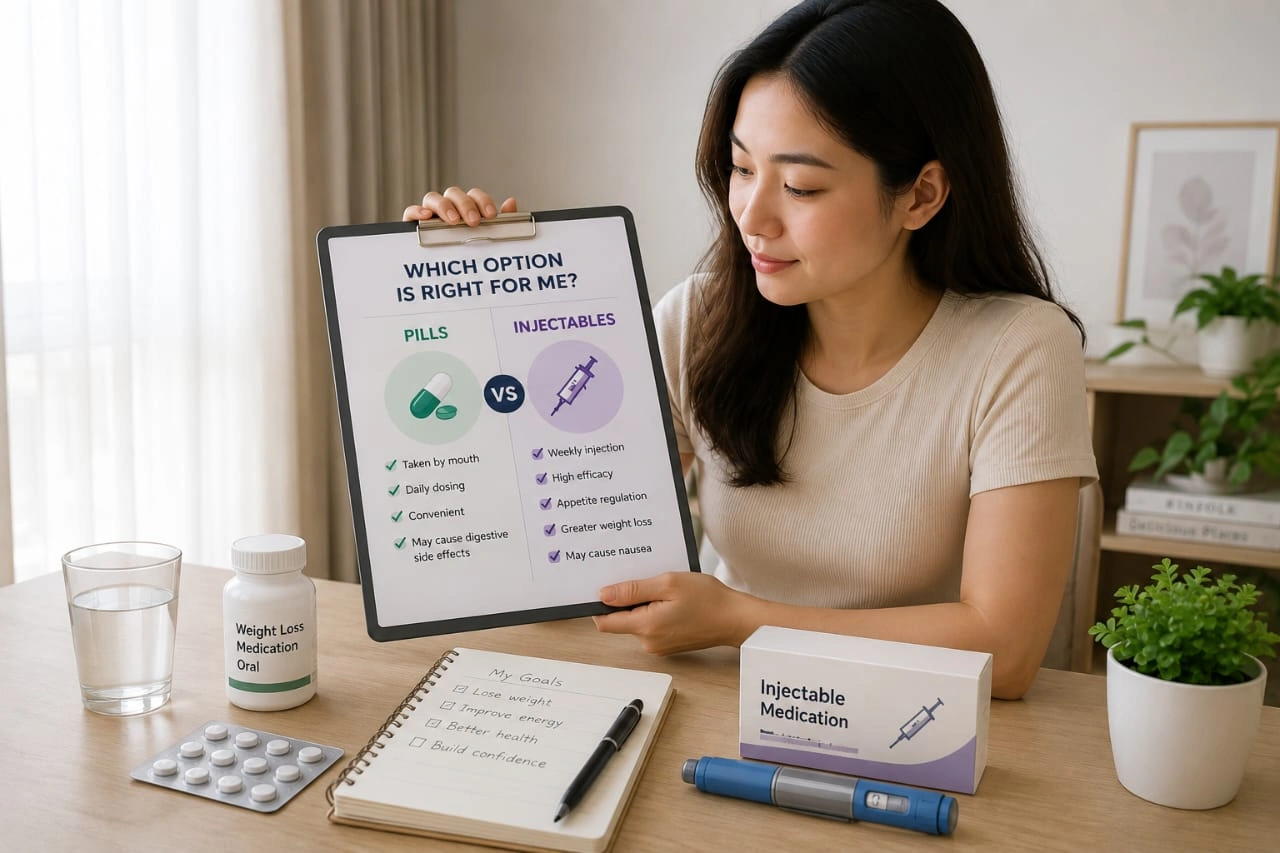
Weight loss medication is becoming more widely discussed in Singapore, especially as more people seek medical support for obesity, metabolic health, and long-term weight management.
In Singapore, doctors may consider prescription weight loss medication for suitable individuals who have not achieved sufficient weight loss despite lifestyle modification, particularly those living with obesity or overweight accompanied by obesity-related health conditions. These medications are intended to complement, rather than replace, healthy eating, regular physical activity, and sustainable lifestyle changes.
But one question comes up often:
“What is the difference between the pills and injectables?”
Both options are used in modern weight loss treatment, but they work differently, suit different patients, and come with different considerations. Understanding the differences can help patients make more informed decisions together with a healthcare professional.
Why Is Weight Loss Medication Prescribed?
Achieving long-term weight reduction is not always simply a matter of willpower. For many patients with obesity or overweight, underlying metabolic factors make losing weight exceptionally difficult through diet and exercise alone.
Research has shown that obesity is a chronic, relapsing disease influenced by complex interactions between genetics, hormones, metabolism, environmental factors, and behaviour. These biological adaptations often make sustained weight loss difficult despite ongoing efforts with diet and exercise alone.
Therefore, a doctor may recommend a prescription medication for weight loss to help:
Regulate Appetite: By acting on hunger signals to reduce food cravings and increase feelings of fullness.
Manage Health Risks: By supporting weight reduction to lower the risk of weight-related health conditions like type 2 diabetes or high blood pressure.
Rather than a short-term fix, weight loss medication works best as a supportive tool. It is always prescribed alongside long-term lifestyle changes, a healthy diet, and regular physical activity to maintain weight loss and prevent future weight regain.
What Are Oral Weight Loss Pills?
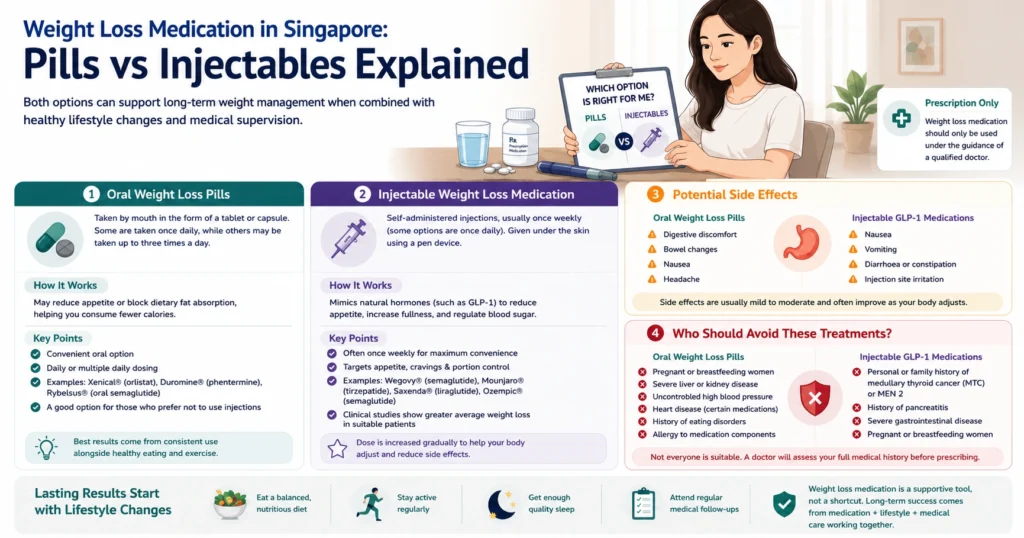
A weight loss pill is taken by mouth, either once daily or up to three times a day, depending on the active ingredient. Some are taken on an empty stomach roughly 30 minutes before eating, while others are taken with main meals.
Oral options generally fall into two categories:
- Traditional Metabolic Tablets: These either act on the brain to regulate appetite or work in the gut to block dietary fat absorption. Examples include Xenical® (orlistat), which reduces fat absorption, and Duromine® (phentermine), an appetite suppressant that is typically prescribed for short-term use under medical supervision.
- Oral GLP-1 Medications: A modern advancement delivering a GLP-1 receptor agonist in tablet form. One example is Rybelsus® (oral semaglutide), which is taken once daily on an empty stomach with a small amount of water. While oral GLP-1 options remain limited compared with injectable formulations, they provide an alternative for individuals who prefer not to use injections.
What Are Weight Loss Injections?
Injectable weight loss treatments have become highly prominent due to the use of GLP-1 medications. GLP-1 (Glucagon-like Peptide-1) is a natural hormone produced by the gut after eating to signal that the stomach is full.
Some of the best-known weight loss injections include Wegovy® (semaglutide), Mounjaro® (tirzepatide), Saxenda® (liraglutide), and Ozempic® (semaglutide). While some of these medications were originally developed to treat type 2 diabetes, certain formulations are now also approved or prescribed for chronic weight management under medical supervision.
Weight loss injections mimic this natural hormone. These advanced treatments support weight reduction by targeting three specific areas in the body:
- The Stomach: They slow down digestion and gastric emptying, helping individuals feel full for a longer period after a meal.
- The Brain: They act directly on hunger centres in the brain to significantly reduce food cravings and regulate daily appetite.
- The Pancreas: They optimise insulin secretion, which helps stabilise overall blood sugar levels.
For maximum convenience, many of these treatments, including Wegovy®, Mounjaro®, and Ozempic®, are administered once weekly using a small, user-friendly pen device designed for simple self-injection beneath the skin. Saxenda®, by comparison, is administered once daily.
Clinical trials have demonstrated that when combined with lifestyle modification, GLP-1 receptor agonists can produce substantial weight loss. Depending on the specific medication and individual response, many patients achieve an average weight reduction of approximately 10% to over 20% of their initial body weight, with tirzepatide showing some of the greatest weight-loss outcomes reported to date.
How Do Weight Loss Pills and Injectables Compare?
The choice between an oral pill and an injectable prescription depends entirely on an individual’s medical profile, baseline body mass index (BMI), and personal health milestones.
| Factor | Oral Weight Loss Pills | Injectable GLP-1 Medications |
|---|---|---|
| Administration | Oral tablet or capsule | Self-administered subcutaneous injection |
| Dosing Frequency | Daily, or multiple times per day | Typically, once per week |
| Primary Mechanism | Fat malabsorption or daily appetite control (including oral GLP-1 options) | Weekly hormonal appetite regulation and hunger control |
| Weight Loss Potential | Modest to moderate weight reduction | Greater average mean weight loss in suitable patients |
| Common Side Effects | Digestive discomfort, bowel changes, or nausea | Nausea, vomiting, and localised injection site irritation |
| Financial Consideration | Generally lower monthly cost | Often represents a higher monthly financial commitment |
What Factors Do Doctors Consider When Recommending Pills or Injectables?
Selecting an appropriate weight loss medication is a strict clinical decision that goes beyond personal preference. Medical professionals evaluate several baseline criteria to ensure safety:
BMI and Adiposity: Confirming whether a patient meets the clinical thresholds for medical intervention (typically a BMI of > 30, or > 27 when paired with high blood pressure or metabolic risks).
Co-morbidities: Reviewing the presence of active chronic health conditions, such as type 2 diabetes, fatty liver, or cardiovascular disease.
Patient Medical Background: Analysing a patient’s medication history and past outcomes from diet and regular exercise.
A highly personalised assessment ensures that any prescribed therapy actively supports a patient’s unique physiology while working effectively to reduce the risk of weight regain over time.
What Are the Potential Side Effects and Contraindications of GLP-1 Medication?
Every pharmacological intervention carries the potential for secondary effects as the metabolic system adapts.
For individuals using GLP-1 drugs (whether in tablet or injection form), clinical management typically focuses on the following considerations:
Gastrointestinal Adaptation: The most frequent complaints involve transient gastrointestinal issues. Patients may experience mild to moderate nausea, vomiting, abdominal pain, bloating, or constipation. These symptoms are usually mild to moderate and often improve over time. Clinical studies have shown that gastrointestinal side effects are most common during the dose-escalation phase and tend to decrease as treatment continues, particularly when the medication is increased gradually according to the recommended dosing schedule.
Reduced Appetite: Because GLP-1 medications help increase feelings of fullness, many patients naturally eat smaller portions and experience fewer food cravings. While this effect contributes to weight loss, some individuals may notice a significant reduction in appetite, especially during the early stages of treatment.
Injection Site Reactions: For injectable GLP-1 medications, mild redness, bruising, itching, or tenderness may occur at the injection site. These reactions are generally temporary and resolve without treatment.
Clinical Dosage Titration: These common effects of GLP-1 treatments are typically temporary. Medical professionals manage them clinically by escalating the medication dosage slowly over several weeks to improve patient tolerance.
When to Seek Medical Attention?
Although serious side effects are uncommon, patients should seek prompt medical review if they develop severe or persistent abdominal pain, repeated vomiting that prevents adequate hydration, signs of an allergic reaction, or symptoms that do not improve despite appropriate dose adjustment.
Who Should Avoid This Treatment?
Weight loss medications are not safe for everyone. Certain health conditions strictly rule out the use of these treatments due to serious medical risks:
Family History of Thyroid Cancer: Individuals must not use GLP-1 medications if they have a personal or family history of Medullary Thyroid Carcinoma (MTC). This strict contraindication also applies to anyone who has ever had a rare genetic condition called Multiple Endocrine Neoplasia syndrome type 2 (MEN 2), as these factors significantly increase serious medical risks.
Pancreas or Gallbladder Issues: Patients with a history of chronic pancreatitis (inflammation of the pancreas) or severe gallbladder disease require careful medical review, as these medications can worsen these conditions. Doctors will typically look for safer alternative treatments.
Conclusion: Choosing the Right Path for Your Weight Management Journey
Both oral weight loss pills and injectable therapies play vital roles in modern, medically guided weight management. Clinical success relies entirely on identifying the specific treatment that aligns with an individual’s unique body mass index (BMI), health history, and long-term metabolic goals.
For individuals seeking structured support without visiting a physical clinic, online teleconsultation platforms like GoMed provide a fully monitored, doctor-led path to weight management. Connecting with a licensed doctor ensures a safe, confidential, and scientifically backed foundation for long-term health success.
References
- Ministry of Health, Singapore. National Population Health Survey 2024. Singapore: Ministry of Health; 2025. Available at: https://www.moh.gov.sg/others/resources-and-statistics/national-population-health-survey–nphs–2024-report/. Accessed June 2026.
- Academy of Medicine Singapore, Ministry of Health Singapore. Obesity: Clinical Practice Guidelines. Singapore: Ministry of Health; 2016.
- Singapore Ministry of Health. Primary Care Pages: Obesity Management in Primary Care. Available at: https://www.primarycarepages.sg (Accessed June 2026).
- Wilding JPH, Batterham RL, Calanna S, et al. Once-weekly semaglutide in adults with overweight or obesity. N Engl J Med. 2021;384(11):989-1002. Available at: https://www.nejm.org/doi/full/10.1056/NEJMoa2032183
- Jastreboff AM, Aronne LJ, Ahmad NN, et al. Tirzepatide once weekly for the treatment of obesity. N Engl J Med. 2022;387(3):205-216. Available at: https://www.nejm.org/doi/full/10.1056/NEJMoa2206038
- Rubino D, Abrahamsson N, Davies M, et al. Effect of Continued Weekly Subcutaneous Semaglutide vs Placebo on Weight Loss Maintenance in Adults With Overweight or Obesity (STEP 4). JAMA. 2021;325(14):1414–1425. doi:10.1001/jama.2021.3224.
- American Diabetes Association. Pharmacologic Approaches to Glycemic Treatment: Standards of Care in Diabetes—2026. Diabetes Care. 2026. https://doi.org/10.2337/dc26-S009