


GLP-1 weight loss medications have become one of the most significant advances in obesity treatment in recent years. As overweight and obesity continue to rise in Singapore, more people are seeking evidence-based medical options to support long-term weight management. According to Singapore’s National Population Health Survey 2024, 22.8% of adults have a BMI of 27.5 kg/m² or above, indicating a high-risk BMI category.
Originally developed to help manage type 2 diabetes, certain GLP-1 medications are now also used to support weight loss in suitable patients living with obesity or other weight-related health conditions.
Despite growing awareness of these treatments, many people still do not fully understand what GLP-1 is, how these medications work, or whether they may be suitable for their individual circumstances.
What Is GLP-1 Weight Loss?
GLP-1 stands for glucagon-like peptide-1, a hormone your body naturally releases after eating.
This hormone plays a role in:
- Appetite regulation
- Digestion
- Blood sugar control
- Hunger and satiety signals
GLP-1 agonists are medications designed to mimic this hormone.
These medications were originally developed to help manage type 2 diabetes by improving blood sugar control and insulin response. During clinical trials, researchers observed that many patients not only achieved better blood sugar control but also experienced clinically significant weight loss.
This discovery eventually led to the use of certain GLP-1 medications as part of medically supervised weight management programmes and obesity treatment.
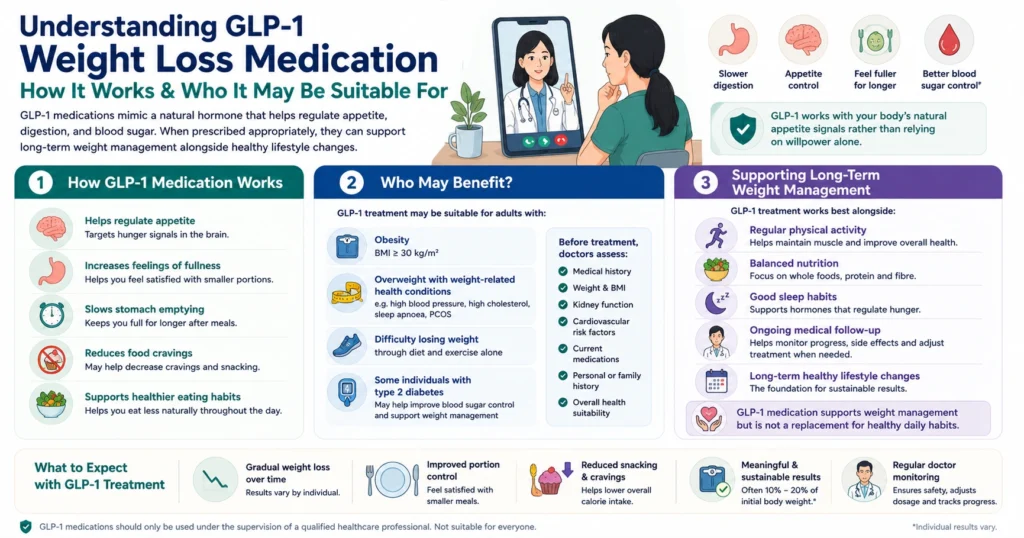
How GLP-1 Medications Work Differently?
Many traditional weight loss approaches focus primarily on reducing calorie intake and increasing physical activity.
GLP-1 medications work differently by targeting biological processes involved in hunger and appetite regulation.
By slowing stomach emptying and enhancing feelings of fullness after meals, these medications may help patients consume fewer calories more naturally throughout the day.
Some patients may experience:
- Reduced cravings
- Better portion control
- Less frequent snacking
- Improved eating habits
By helping patients feel full sooner and stay full for longer, GLP-1 medications often reduce overall calorie intake without requiring constant hunger or strict calorie restriction. This makes it easier for many people to maintain healthier eating habits over time.
How Is GLP-1 Treatment Taken?
GLP-1 medications are available in both injectable and oral forms, depending on the specific medication and its approved use.
Many GLP-1 treatments used for weight management are administered as once-weekly injections. These medications are typically delivered through a small subcutaneous injection beneath the skin of the abdomen, thigh, or upper arm. Doctors will provide guidance on proper injection techniques and how to rotate injection sites safely.
Common injectable GLP-1 medications used for weight management include:
- Wegovy® (semaglutide) – a once-weekly injection approved for chronic weight management.
- Saxenda® (liraglutide) – a once-daily injection prescribed for weight management.
- Mounjaro® (tirzepatide) – a once-weekly injection that has shown significant benefits for weight loss and may be prescribed for obesity management depending on clinical suitability.
- Zepbound® (tirzepatide) – a once-weekly injection specifically approved for chronic weight management in certain countries.
- Ozempic® (semaglutide) – although primarily indicated for type 2 diabetes, it may sometimes be prescribed off-label for weight management under medical supervision.
Some GLP-1 medications are also available as oral tablets. Examples include:
- Rybelsus® (oral semaglutide) – an oral GLP-1 medication primarily approved for type 2 diabetes, though it may be considered in selected cases.
- Orforglipron – an investigational oral GLP-1 receptor agonist currently undergoing clinical development and not yet widely available.
The most suitable option depends on factors such as a patient’s medical history, treatment goals, lifestyle preferences, and clinical suitability.
Treatment usually begins with a lower dose before being increased gradually over several weeks. This gradual dose escalation helps the body adjust to the medication and may help reduce side effects such as nausea and digestive discomfort. Patients should only use GLP-1 medications under the guidance of a qualified healthcare professional.
Who May Be Suitable for GLP-1 Weight Loss?
GLP-1 treatment is not designed for casual or cosmetic weight loss alone.
These medications are generally considered for adults with:
- Obesity
- Overweight alongside weight-related health conditions
- Difficulty achieving effective weight loss through diet and exercise alone
Some patients with type 2 diabetes may also benefit from GLP-1 medications because of their role in blood sugar control.
A healthcare provider will usually review:
- Health history
- Body weight
- Kidney function
- Cardiovascular risk factors
- Existing medications
- Personal or family history of certain conditions
This helps determine whether GLP-1 treatment is safe, appropriate, and clinically indicated for eligible individuals.
How Much Weight Loss Can You Expect with GLP-1 Treatment?
Weight loss varies from person to person and depends on several factors, including the medication prescribed, starting body weight, adherence to treatment, dietary habits, physical activity, and underlying medical conditions.
Clinical trials have shown that when combined with lifestyle modifications, GLP-1 medications can help suitable patients achieve meaningful and sustained weight loss. Many patients achieve weight loss of approximately 10% to 20% of their initial body weight, although the amount lost varies among individuals. Factors such as the prescribed medication, treatment adherence, lifestyle changes, and underlying health conditions all influence the overall results.
It is also important to understand that GLP-1 medications are not intended to produce rapid weight loss. Most people lose weight gradually over several months as the medication dose is increased and healthy lifestyle habits are maintained. Regular follow-up with your doctor allows treatment to be adjusted where appropriate and helps support safe, sustainable weight management.
What Are the Common Side Effects?
Like all medications, GLP-1 medications carry both risks and benefits.
The most common side effect is nausea, especially during the early weeks of treatment or when the dose is increased.
Other common side effects may include:
- Bloating
- Constipation
- Mild digestive discomfort
- Diarrhoea
- Injection site irritation
These symptoms are often mild to moderate and may improve over time as the body adjusts.
More serious but less common risks can include low blood sugar, pancreatitis, or gallbladder-related issues, which is why regular monitoring remains important during treatment.
Patients with a personal or family history of medullary thyroid cancer or multiple endocrine neoplasia may not be suitable for certain GLP-1 agonists.
Is GLP-1 Weight Loss a Long-Term Solution?
GLP-1 medications can support significant weight reduction for many patients, but they are not a standalone solution.
The best results usually happen when treatment is combined with lifestyle modifications such as:
- Regular exercise
- Balanced nutrition
- Sleep management
- Sustainable eating habits
Doctors may also monitor lean muscle mass during treatment to support healthier long-term outcomes.
It is also important to understand that stopping treatment suddenly without maintaining lifestyle changes may contribute to weight regain in some individuals.
This is why GLP-1 weight management should be approached as part of a broader long-term treatment plan rather than a short-term fix.
What Should You Know Before Starting GLP-1 Treatment?
GLP-1 medications can be safe and effective when prescribed appropriately and monitored by a healthcare professional.
Before starting GLP-1 medication treatment, patients should understand:
- How the medication works
- Potential weight loss outcomes
- Possible side effects
- Monitoring requirements
- Expected treatment timelines
A doctor can assess whether GLP-1 weight loss treatment is appropriate based on an individual’s medical history, health goals, and overall suitability.
For suitable patients, telemedicine consultations may also provide a convenient way to discuss weight management options, review eligibility, and receive ongoing medical follow-up where clinically appropriate.
References
- Ministry of Health, Singapore. National Population Health Survey 2024. Singapore: Ministry of Health; 2025. Available at: https://www.moh.gov.sg/others/resources-and-statistics/national-population-health-survey–nphs–2024-report/. Accessed June 2026.
- American Diabetes Association. Standards of Care in Diabetes—2025. Diabetes Care. 2025;48(Suppl 1). Available at: https://diabetesjournals.org/care/issue/48/Supplement_1. Accessed June 2026.
- American Association of Clinical Endocrinology. Clinical Practice Guideline for Comprehensive Care of Patients with Obesity. Endocrine Practice. 2022;28(5):528–562.
- National Institute for Health and Care Excellence>. Obesity: Identification, Assessment and Management (CG189). Available at: https://www.nice.org.uk/guidance/cg189. Accessed June 2026.
- Wilding JPH, Batterham RL, Calanna S, et al. Once-weekly semaglutide in adults with overweight or obesity. N Engl J Med. 2021;384(11):989-1002. Available at: https://www.nejm.org/doi/full/10.1056/NEJMoa2032183
- Jastreboff AM, Aronne LJ, Ahmad NN, et al. Tirzepatide once weekly for the treatment of obesity. N Engl J Med. 2022;387(3):205-216. Available at: https://www.nejm.org/doi/full/10.1056/NEJMoa2206038
- U.S. Food and Drug Administration. Wegovy (semaglutide) Prescribing Information. Available at: https://www.accessdata.fda.gov/drugsatfda_docs/label/2025/215256s024lbl.pdf. Accessed June 2026.
- U.S. Food and Drug Administration. Mounjaro (tirzepatide) Prescribing Information. Available at: https://www.accessdata.fda.gov/drugsatfda_docs/label/2022/215866s000lbl.pdf. Accessed June 2026.